


Tracking sales, purchases, expenses, invoices, inventory, accounts, and multiple branches through separate systems can lead to duplicated data, delayed reports, and difficulty gaining a clear view of overall financial performance.
This is where an Integrated Financial & Accounting System can make a difference. By bringing financial and accounting operations together on one platform and connecting them with sales, purchasing, inventory, and branch operations, businesses can improve data accuracy, streamline workflows, and make decisions based on up-to-date information.
What Is an Integrated Financial & Accounting System?
An integrated financial and accounting system is a software solution that allows businesses to manage their financial and accounting operations through a centralized platform.
Instead of manually entering sales or purchasing data and transferring information between different systems, an integrated system connects these operations within a unified workflow.
For example, when a sale is recorded, the related data can be reflected across accounting, inventory, and financial reporting, depending on the system's configuration.
This creates a more connected view of:
• Sales and revenue
• Purchases and suppliers
• Expenses
• Accounts receivable and payable
• Invoices
• Inventory and inventory costs
• Branches and warehouses
• Financial reports
• Cash flow
• Business performance
By connecting these processes, an integrated system reduces reliance on spreadsheets and manual data entry while creating a more organized financial environment.
Why Do Businesses Need an Integrated Financial & Accounting System?
As a business grows, financial challenges go beyond simply recording transactions. Management needs to connect financial information with the operational activities taking place every day.
For example, a sale may take place at one branch, inventory levels may change, and the finance team may need to understand the transaction's impact on revenue and accounting records.
When separate systems are used, this information may need to be transferred or reviewed manually. With an integrated system, these processes can be connected within a single workflow.
1. Reduce Manual Data Entry
The more businesses rely on manual data entry, the greater the possibility of errors, duplicated information, and delays. An integrated financial system can automate parts of the data flow between different business operations, reducing the time required to enter and review information.
2. Centralize Financial Data
Keeping financial data on a centralized platform makes information easier to access and reduces inconsistencies between departments or branches.
Instead of relying on multiple spreadsheets or disconnected systems, teams can work with a unified source of business data.
3. Access Up-to-Date Financial Reports
Management needs visibility into the company's financial position without waiting for data to be collected from multiple sources.
An integrated system can provide reports based on recorded business transactions, giving management a clearer view of revenue, expenses, and financial performance.
4. Manage Multiple Branches
For businesses with multiple branches, financial management becomes more complex as transaction volumes increase.
An integrated financial and accounting system can help manage financial data and branch-related operations from a centralized platform, while allowing businesses to analyze performance by branch or business activity based on the system's configuration.
5. Connect Finance with Inventory and Sales
One of the key benefits of an integrated system is that it does not treat accounting as a process completely separate from daily business operations.
Sales, purchases, and inventory can be connected with financial operations, giving management a more comprehensive view of business performance.
Key Functions of an Integrated Financial & Accounting System
When choosing a financial and accounting system for businesses, it is important to look beyond basic income and expense tracking.
The system should support the broader financial workflow and connect accounting with the operational processes that generate financial data.
Account Management
An integrated system helps businesses organize accounts and manage financial transactions according to the company's accounting structure. Finance teams can monitor accounts, transactions, and accounting entries in a more structured environment.
Sales Management
Sales transactions can be connected with financial data, allowing sales activities to become part of the broader data flow within the system.
This is particularly important for businesses that process a high volume of daily transactions or operate multiple branches.
Purchasing and Supplier Management
For many businesses, the financial cycle starts with purchasing. Connecting purchasing with accounting and supplier management can improve visibility into financial commitments, payments, and expenses associated with procurement.
Expense Management
Instead of tracking expenses through separate spreadsheets or systems, businesses can record and organize expenses within the platform and connect them with relevant accounts and financial reports.
Accounts Receivable and Payable
These functions help businesses monitor amounts owed by customers and amounts payable to suppliers.
This gives finance teams greater visibility into outstanding receivables, upcoming payments, and financial obligations.
Financial Reporting
Reporting is one of the most important components of a financial and accounting system.
Depending on the system's capabilities and configuration, reports may include:
• Income statements
• Balance sheets
• Cash flow reports
• Sales reports
• Expense reports
• Purchasing reports
• Branch performance reports
• Account reports
• Supplier and customer reports
An Integrated Financial & Accounting System and Inventory Management
Accounting and inventory may appear to be separate functions, but they are closely connected in businesses that sell products.
When products are purchased, inventory value and financial liabilities can be affected. When products are sold, inventory levels, revenue, and related costs change.
Connecting inventory management with financial and accounting operations can therefore reduce the gap between operational and financial data.
This is particularly important for pharmacies, retail businesses, and distribution companies that manage large product catalogs, inventory volumes, and multiple branches.
Financial & Accounting Systems for Multi-Branch Businesses
Managing the finances of a single-location business is very different from managing a company with dozens or hundreds of branches. For multi-branch businesses, management may need visibility into:
• Sales by branch
• Expenses
• Inventory movement
• Purchases
• Branch performance
• Revenue
• Financial obligations
• Differences in performance between branches
A centralized system helps bring this information together in one environment rather than relying on separate files for each location.
Management can also use this data to analyze branch performance and identify changes in sales, expenses, and inventory.
The Importance of POS Integration
For retail stores, pharmacies, and beauty businesses, many financial transactions begin at the point of sale.
That makes integration between a POS system and financial and accounting software important for creating a more connected flow of operational and financial data. When a sale is completed, the transaction can become part of a broader workflow involving sales, inventory, accounting, and reporting.
This reduces the need to enter the same information into multiple systems.
Financial & Accounting Systems and Compliance
Businesses operating in regulated markets need systems that can support relevant financial and invoicing requirements.
In Saudi Arabia, compliance with the requirements of the Zakat, Tax and Customs Authority (ZATCA) is an important part of managing invoicing and accounting operations.
When selecting a financial and accounting system, businesses should therefore evaluate whether it supports electronic invoicing and the relevant compliance requirements of their target market.
How Does an Integrated System Support Better Decision-Making?
Management does not simply need more data. It needs organized and connected data that can support business decisions.
For example, management may need to understand:
Have expenses increased?
Which branches generate the highest sales?
Which products have higher sales volumes?
Has inventory value increased?
How much do customers currently owe the business?
What amounts are payable to suppliers?
How has revenue changed over a specific period?
When these data points are connected, management can analyze business performance more efficiently instead of relying on assumptions or manually prepared reports.
Juleb: Integrated ERP for Financial and Business Management
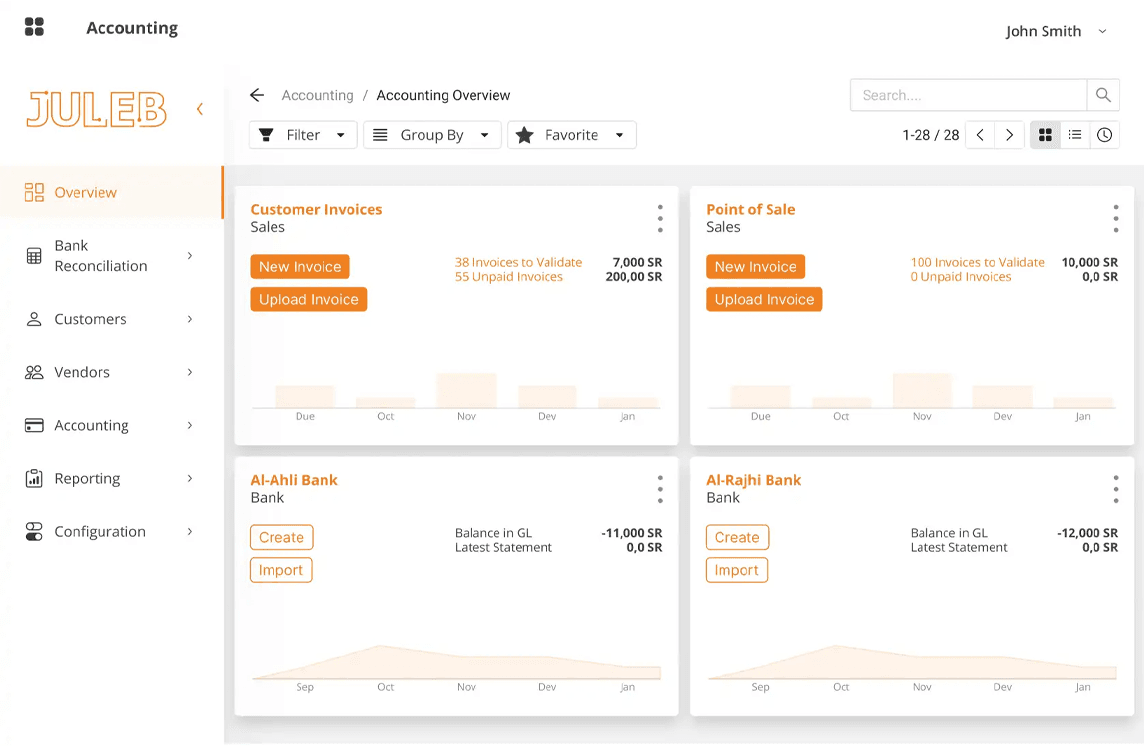
Juleb ERP provides an integrated environment that helps businesses connect financial operations with their broader business processes through one platform. Instead of managing accounting, sales, purchasing, inventory, and branches as disconnected systems, Juleb helps bring these operations together and connect the data between them.
The Juleb ecosystem includes functions that can support the broader business workflow, such as:
• Financial and accounting management
• Sales management
• Purchasing management
• Inventory management
• Point of Sale (POS)
• Branch management
• Warehouse management
• Reporting and analytics
• Customer and supplier management
This integration helps businesses reduce manual work, organize data more effectively, and gain a more comprehensive view of financial and operational performance.
How to Choose the Right Financial & Accounting System
Before selecting a system, businesses should evaluate both their current requirements and future growth plans. Some of the key factors to consider include:
1. Integration:
Does the system integrate with sales, inventory, purchasing, and POS operations?
2. Scalability:
Can it support an increasing number of branches, users, and transactions?
3. Reporting:
Does it provide the reports required by finance teams and management?
4. Automation:
Does it reduce manual processes and duplicate data entry?
5. Compliance:
Does it support the relevant regulatory and electronic invoicing requirements in the target market?
6. Accessibility:
Can authorized teams easily access the information they need?
7. Connected Operations:
Does accounting operate as part of an integrated business environment, or is it isolated from other business processes?
Conclusion
Financial management is no longer limited to recording revenue and expenses. As businesses expand and transaction volumes increase, they need an Integrated Financial & Accounting System that connects financial data with daily business operations.
By connecting accounting with sales, purchasing, inventory, POS, and branch management, businesses can create a more organized workflow, reduce reliance on manual processes, and gain clearer visibility into financial and operational performance.
If you are looking for a platform that brings together financial and accounting management, ERP, inventory, sales, POS, and branch management, Juleb can help you manage your business operations from one integrated platform.
Book a free demo with Juleb and discover how an integrated financial and accounting solution can support your business growth.